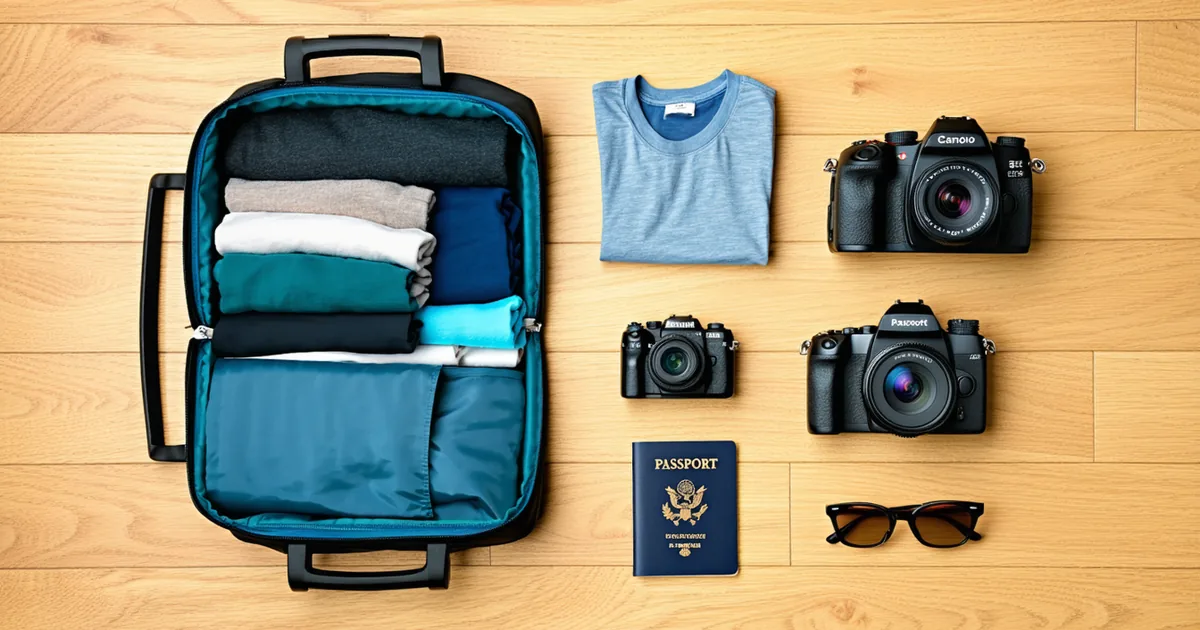
The first time you travel with only a carry-on bag — actually commit to it, for a real trip, not just a long weekend — something odd happens. The trip feels different before it even begins. You walk off the plane and directly toward the exit, without the slow orbit around a baggage carousel that signals, somewhere in your nervous system, that this arrival is contingent, waiting, not yet begun. You are, immediately, wherever you are.
That feeling is what carry-on travel is actually about. The packing itself is secondary.
The Trip That Changes When You Pack Light
Travelling without checked luggage changes the structure of a trip in ways that aren't obvious until you've experienced them. You can take the later train without logistics anxiety. You can make a last-minute decision to extend somewhere by two days without calculating what happens to a checked bag that was supposed to fly forward. You can walk from the airport to the metro to the hotel without the four-wheeled anchor pulling behind you.
More subtly: when your possessions are fewer and more chosen, your relationship to them shifts. You stop accumulating as a hedge against uncertainty — "I might want this, I might need that" — because you've already resolved those questions in advance and found the answer to most of them was no. That resolution carries into the trip. You're less encumbered, in a literal sense, and that has a psychological texture that's genuinely pleasant.
None of this means carry-on travel is objectively superior. It's not. There are trips — a month in multiple climates, a trip with formal occasions plus outdoor activities, travelling with a young child — where checking a bag is simply the right choice. The point isn't that one mode is better; it's that the carry-on constraint, when it fits the trip, changes the travel experience in ways that go beyond saved baggage fees.
The Actual Packing Question
Most carry-on packing advice is a list of things to bring and not bring, and the lists are all roughly the same: merino wool, quick-dry fabrics, three-to-five days of clothing on a rotation, one smart option for an evening out, toiletries under 100ml. This advice is correct and doesn't need repeating at length.
The more useful question is: what are you actually trying to preserve the option for, and is it realistic? Most overpacking happens because of hypothetical scenarios — "what if there's a formal dinner?", "what if the weather turns cold?", "what if I want to go running every day?" — that don't survive contact with how trips actually go.
Practical test: think about your last two or three trips. What did you carry that you never used? That list is probably long and depressingly consistent. The things you never used are almost always the hedges — the formal shoes, the backup outfit, the book you never opened because you had your phone. Cutting hedges is the entire packing exercise.
What to Actually Pack for 7-10 Days
The standard carry-on-only wardrobe for a week-plus trip to a warm or mild city climate: three bottoms (two casual, one that can work smart-casual), five or six tops that can be layered or worn alone, one light jacket or layering piece, one pair of walking shoes that are also acceptable for dinner, one pair of sandals or casual flats if it's warm. That's it for clothing. It fits. It covers the scenarios that will actually occur.
For colder weather: same principle, denser fabrics. A merino base layer handles a wide temperature range and washes overnight. A mid-layer down jacket compresses to almost nothing. The principle of "three bottoms, five tops, one jacket" still works — you're just wearing more of it at once.
Electronics are where people consistently over-pack in a different way. You almost certainly don't need two cameras, a tablet, and a laptop plus a phone for a leisure trip. One of those things is your primary device; the others are redundancy you're carrying in case of a failure scenario that almost never happens. Ask honestly whether the marginal safety of two devices is worth the weight and the airport anxiety about what's in the bag.
The Laundry Question
Carry-on travel for trips longer than five days requires engaging with laundry. This is less onerous than it sounds. Most hotels will do laundry if you ask — at a price. Most cities have a laundromat within reasonable distance, and spending ninety minutes in a laundromat in a foreign city is actually one of the stranger and more pleasant ways to spend a morning — quiet, local, a window into ordinary life that the tourist circuit doesn't show you.
For shorter trips, sink laundry with quick-dry fabrics solves most of the problem. Merino wool and technical travel fabrics dry overnight when hung. A few items washed and dried overnight extends a five-day wardrobe indefinitely, in theory — though in practice, most people find they use laundry services every four or five days rather than nightly.
The Things Worth Not Cutting
Carry-on travel has genuine constraints, and pretending otherwise is unhelpful. Some things belong in checked luggage: any liquid more than 100ml that you actually need (specific skincare, medication in larger quantities), sharp tools, formal shoes for a trip where you genuinely have formal occasions multiple times. If you have these requirements, check a bag. The philosophy doesn't require martyrdom.
Similarly: travelling with a chronic health condition that requires equipment, or with a baby, or to a destination with extreme climate variation in a single trip — these all have legitimate requirements that a carry-on constraint can't accommodate without genuinely compromising the trip. The principle here is that carry-on should be a considered choice based on what your specific trip requires, not a rule applied without thinking about what it costs you.
The First Step
If you've never done it: pick a trip where the conditions are favourable — one climate zone, a week or less, no formal occasions — and commit fully. Pack what fits in the bag you've chosen, and don't allow overflow. If something doesn't fit, it doesn't come. The trip will go fine. In fact, the trip will probably feel notably better than the trip where you arrived with a large bag that shaped every morning around not losing it.
You'll know when you walk off that first flight without looking for a carousel whether the philosophy is worth keeping.